Policy | 12 May 2026
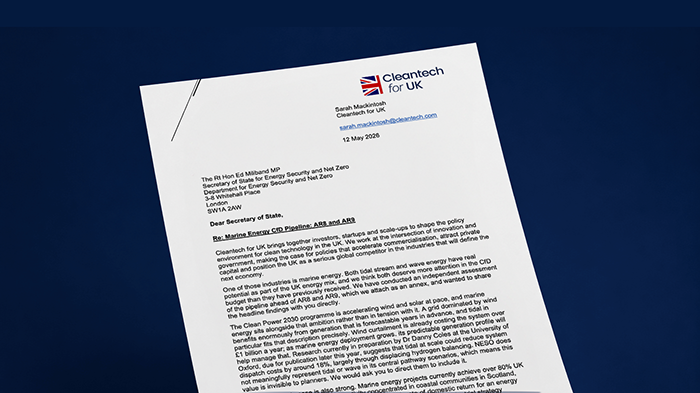
Cleantech for UK has submitted a formal letter to the Secretary of State for Energy Security and Net Zero, setting out the case for a meaningful ringfence for tidal stream and wave energy in allocation rounds AR8 and AR9 of the Contract for Difference programme. The letter is accompanied by an independent pipeline assessment covering all credible near-term projects across both technologies.
Our conclusion is direct: budget is the binding constraint, not developer appetite. The supply is there. A credible cohort of UK tidal developers is at or near bid readiness. What is missing is the policy commitment to unlock them.
"The Marine Energy Council is calling for a £40 million tidal ringfence in AR8. Based on current strike prices, that would unlock somewhere in the region of 35 to 40 MW. In our view that should be treated as a floor rather than a ceiling."
Sarah Mackintosh, Director, Cleantech for UK
The Clean Power 2030 programme is rightly accelerating wind and solar. Marine energy sits alongside that ambition rather than in tension with it. A grid increasingly dominated by variable renewables gains enormously from generation that is forecastable years in advance. Tidal, in particular, fits that description precisely.
Wind curtailment is already costing the system over £1 billion a year. Research currently in preparation by Dr Danny Coles at the University of Oxford suggests that tidal at scale could reduce system dispatch costs by around 18%, largely through displacing hydrogen balancing. NESO does not meaningfully represent tidal or wave in its central pathway scenarios, which means this system value is currently invisible to planners. We have asked the Secretary of State to direct them to include it.
The supply chain case is equally strong. Marine energy projects currently achieve over 80% UK content, with jobs concentrated in coastal communities in Scotland, Wales and the north-west. That is an unusually high rate of domestic economic return for a technology at this stage of development, making marine energy as much an industrial strategy opportunity as an energy one.
Our independent assessment covers the near-term pipeline ahead of AR8, launching in July 2026, and AR9, expected to follow in 2027.
For AR8, we assessed a central tidal pipeline of 77 MW, with a low of 55 MW and an upside of 102 MW. Six developers are at or near bid readiness with consents and grid connections in place: MeyGen in the Pentland Firth, Orbital Marine Power at Westray Firth, Nova Innovation, Magallanes, QED Naval and Tidal Technologies.
For AR9, the central pipeline reaches 107 MW across tidal, with upside to 166 MW. Wave capacity of up to 10 MW is possible but is entirely conditional on a dedicated wave ringfence; without one, wave cannot clear in the current Pot 2 structure. Developers including CorPower Ocean and Mocean Energy are approaching first commercial array readiness and a first allocation would unlock private investment behind them.
Consumer cost sensitivity is a legitimate consideration, particularly as decoupling electricity prices from gas may make CfD top-up payments more persistent under the reformed market structure. Our answer is the wind precedent. Early premium prices built an industry that now delivers some of the cheapest power on the system, and many early CfD contracts now generate net savings for consumers.
Tidal is earlier on that same curve. Its strike price fell 34% between AR4 and AR6 on very limited deployment. The system value of predictable, forecastable generation in a decoupled market, reducing balancing costs and displacing expensive backup capacity, makes the case for bearing that premium now. For context, AR7 allocated £1.79 billion to offshore wind alone. The ask here is modest.
For AR8, we are asking for a ringfence sized to accommodate between 55 and 100 MW of credible near-term tidal capacity. The Marine Energy Council is calling for a £40 million ringfence; based on current strike prices that would unlock around 35 to 40 MW. We think that should be treated as a floor, not a ceiling.
For AR9, we are asking for a tidal ringfence of at least £60 million and a dedicated wave ringfence of £7 to £10 million. The current Pot 2 structure asks very different technologies at very different stages of maturity to compete on price against each other, and that works against all of them.
Beyond AR9, we are asking for a provisional indication of ringfence levels going forward. The single biggest barrier to private capital across all of these technologies is uncertainty about whether support will continue. Even an indicative commitment would make a material difference to investment decisions being taken now.
We are happy to discuss the underlying data and methodology with officials. The full letter and pipeline assessment are available below.