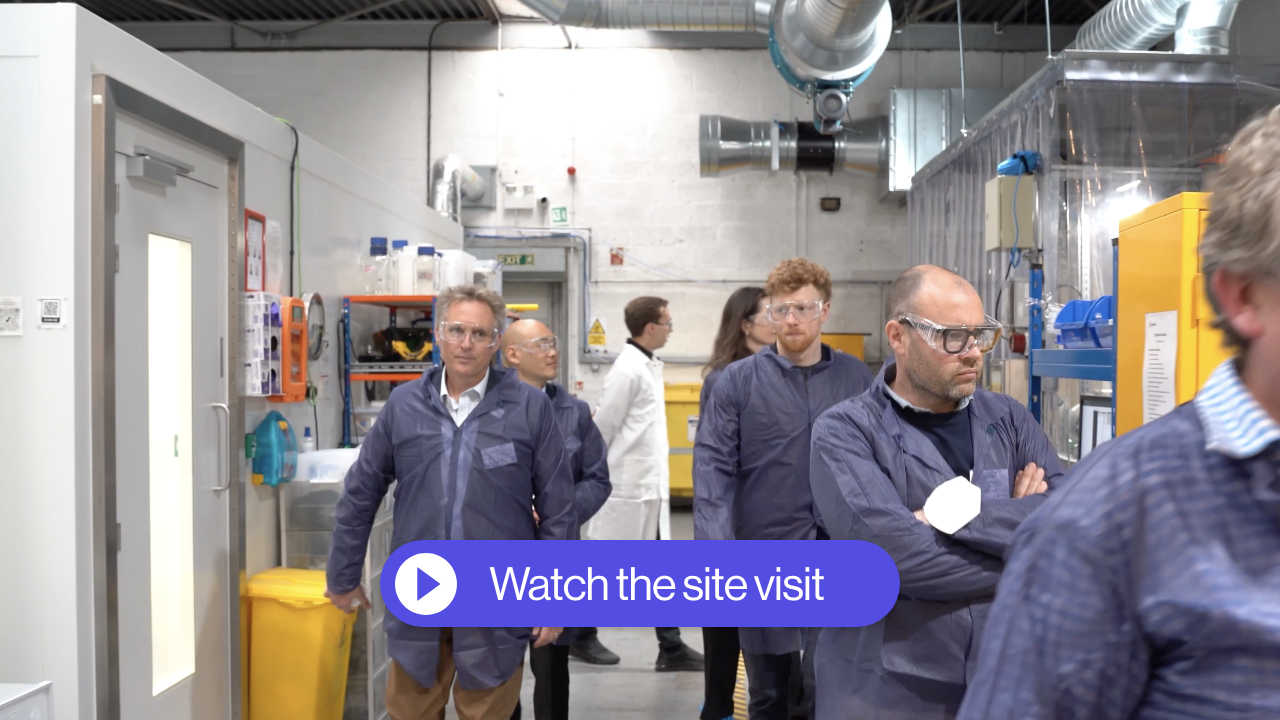
Last month, Cleantech for UK were delighted to support Elbow Beach on their recent Modern Industrial Showcase in Bristol, where a collection of investors, civil servants, and experts joined us to celebrate the work of two cleantech pioneers: Wase and Anaphite.
The visit started with a tour of Anaphite's battery manufacturing facility, where the team are developing a genuinely novel approach to electrode production. Anaphite's dry coating technology eliminates the need for the energy-intensive ovens required in conventional wet coating processes, which currently dominate over 90% of global lithium-ion electrode production. The implications are significant: independent lifecycle analysis suggests the technology could reduce carbon emissions by the equivalent of 7 million tonnes annually if applied to global battery production. The company was founded by chemist Sam Burrow and physicist Alexander Hewitt, who met at the University of Bristol and filed their first patent in 2018. Elbow Beach is itself an investor in Anaphite, having participated in a recent £1.4 million Innovate UK-matched funding round to advance the industrialisation of the dry electrode coating process. Seeing the technology up close made clear why this has attracted serious backing: it sits at the intersection of the UK's industrial strategy priorities and the urgent need to decarbonise the EV supply chain.
The second half of the day turned to Wase, also Bristol-based, which is transforming the way industrial businesses think about their waste streams. Wase's proprietary Electro-Methanogenic Reactor (EMR) technology increases biogas generation by 30%, up to ten times faster than conventional anaerobic digestion, while boosting methane content to over 80% compared to the 50-60% typical of standard AD systems. The plug-and-play system is 50-70% smaller than existing alternatives and fits into existing infrastructure, making it a practical option for food and beverage manufacturers and other industrial sites seeking to treat wastewater on-site while generating renewable energy. Wase already works with customers including Hepworth. The potential to turn a cost centre into an energy asset resonated strongly with the investors in the room.
Together, the two visits told a broader story about the depth of cleantech innovation happening outside London. Bristol alone is home to companies working across battery materials, waste-to-energy, and beyond, and days like this serve an important function in making that visible to the people who can back it. The South West is not a footnote in the UK's net zero transition; it is one of its most productive chapters.